Beyond the medals at Trinbago 2023
With one year to go until the Commonwealth Youth Games in Malta, attention is turning to the next generation of athletes preparing to represent their countries on the international stage. But a look back at Trinidad and Tobago in 2023 reveals how much the Youth Games can offer beyond medals and records.
Trinbago provided many young competitors with their first taste of international competition, the opportunity to experience different cultures, forge friendships and discover what it means to be part of a major multi-sport event.
The four athletes representing Niue returned home without medals, but with four personal bests between them, including a fourth-place finish in the shot put for McFitu Tukuniu, and the experience of competing against some of the Commonwealth's most promising young talent.
Tukuniu, Tagavaitoa Tukuitoga, Ramsi Edwards and Hikuleo Lui represented the small Pacific island nation in Athletics field events, with their performances delighting Chef de Mission Maxine Edwards.
“We are extremely happy with the results from each athlete, they all managed to get personal best,” she told Broadcasting Corporation of Niue. "The Trinbago Games was all about exposure to the international stage of Competition.”
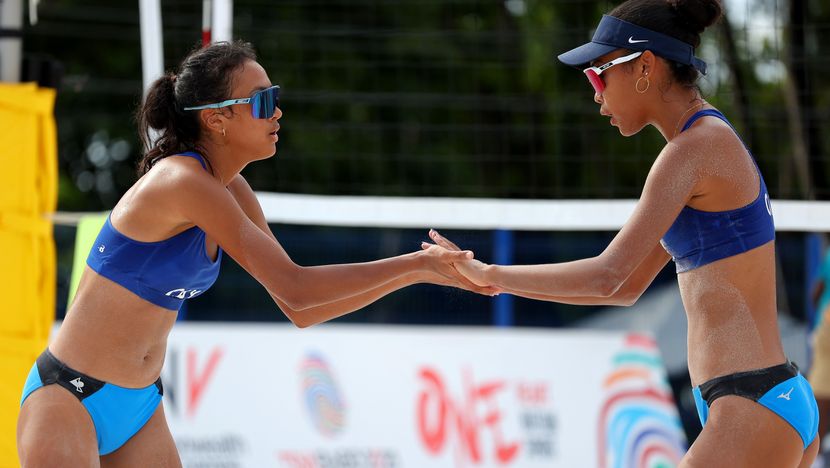
Sisters Anjia and Brianna Delapenha, representing the Cayman Islands in Beach Volleyball, had a rather different experience.
Aged 18 and 16 respectively, the pair had already travelled extensively for competitions, but Trinbago 2023 proved particularly memorable.
Following a straight-sets defeat to England, Anjia spoke enthusiastically about the organisation of the event and the measures in place to protect young competitors.
“For the first time I feel like royalty,” she told Commonwealth youth reporter Jada Chambers, praising the security arrangements and the attention given to athlete welfare.
There was also a personal significance to the occasion. With Anjia preparing to leave for university in the United Kingdom, the sisters knew their time competing together was coming to an end.
“My sister is going to go off to college so that leaves me on the island alone,” Brianna explained, acknowledging that she would need to find a new playing partner.
Trinidad and Tobago's Isaiah Williams had his own reasons to remember the Games.
The 17-year-old sprinter, who has cerebral palsy, was representing his country for the first time as Para Athletics made its Commonwealth Youth Games debut.
Williams reached the final of the men's T38 100m, finishing eighth in 18.91 seconds. But his experience extended far beyond the track.
“For me, this has been a life changer,” he told Commonwealth Sport in an interview published during the Games, reflecting on his first experience of being part of a national team, staying in hotels and interacting with athletes from other countries.
Williams also hoped his participation would encourage greater acceptance of people with disabilities in Trinidad and Tobago, while looking forward to welcoming competitors from across the Commonwealth to his homeland.
Scotland's Lidya Woldeselassie was another young Para athlete making history without reaching the podium.
At just 14, she was the youngest member of Scotland's 49-strong delegation and became the country's first Para athlete to compete at a Commonwealth Youth Games.
Woldeselassie reached the women's T35–38 100m final, finishing seventh in a personal best time of 19.14 seconds, before taking sixth place in the long jump with another personal best of 2.49m.
Her performances offered a glimpse of what the inaugural Para athletics programme could mean for young athletes gaining international experience.
The friendships made during Trinbago were another important part of the experience.
England's Eliza Nicholson, who had taken up running just two years earlier, won bronze in the women's 3000m but was equally enthusiastic about the people she had met.
“It's been an amazing Games and I've made friends for life here,” she told Team England.
Those wider benefits were also reflected in a post-Games survey conducted by Commonwealth Games Australia. Some 83 per cent of Australian team members and support staff who responded believed the Youth Games played a critical role in developing elite athletes.
Alongside the sporting benefits, respondents highlighted travelling with competitors from other disciplines, representing their country and experiencing different cultures.
Trinidad and Tobago's distinctive culture provided another dimension to the event.
The Carnival-inspired opening ceremony featured steel pan music, traditional tassa drums and colourful Moko Jumbie stilt walkers, while the Games concluded with a beachside celebration at Pigeon Point in Tobago.
The experience also extended into the local community. Team England competitors visited sports clubs, helped deliver training sessions and donated equipment, including 60 pairs of running spikes, to aspiring young athletes.
When Malta welcomes approximately 1,200 young athletes from across the Commonwealth in October 2027, there will be new experiences on and off the field of play.
The eighth Commonwealth Youth Games will introduce Sailing, 4x4 Water Polo and Para Swimming, alongside an expanded Para Athletics programme, providing further opportunities for young competitors to experience international sport.
Some will return home with medals and records, while others will be representing their countries for the first time or travelling further from home than ever before.
As the experiences of Niue's athletes, the Delapenha sisters, Williams and Woldeselassie demonstrate, the Youth Games can leave a lasting impression regardless of where an athlete finishes.
And when the next generation gathers in Malta, the friendships, experiences and memories they take home may prove every bit as important as their performances.
